Compute overview
The Nextmv Platform provides a framework for effectively building, testing, and managing your decision models. The platform traditionally executes your models on Nextmv-provided compute resources, with capabilities determined by the execution class and runtime you provide starting a run. With the introduction of compute integrations, you can now utilize your own compute resources for model execution. This allows you to retain control over your compute environment while still leveraging Nextmv's platform capabilities for orchestration, management, tracking, and experimentation for decision models.
Nextmv offers the following compute integrations:
| Integration | Description |
|---|---|
| Databricks | Use a Databricks Job as a compute target for your Nextmv runs. |
| AWS Batch | Use an AWS Batch Job Queue and Job Definition as a compute target for your Nextmv runs. |
How compute integrations work
You define integrations at the account level, and control if an integration is globally available or assigned to specific apps. Each compute integration requires attributes related to the specific type. Once defined, runs utilizing integrations function identically to standard Nextmv runs, maintaining the same features such as experimentation and ensemble capabilities.
You have the flexibility to define multiple integrations for each external compute provider. This allows you to differentiate between various environments within your own platforms, such as environments with different installation packages, distinct memory/compute specifications, or different internal access policies.
A Nextmv run lifecycle is governed by a session protocol. With the introduction of compute integrations, this session protocol can operate across remote system boundaries.
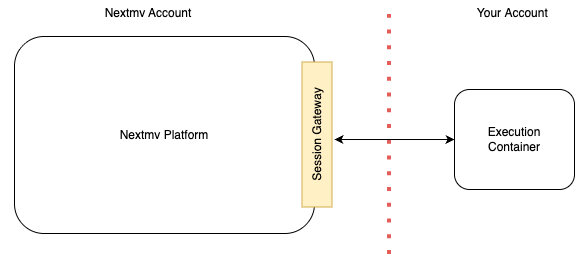
The Nextmv control plane manages the execution of customer models by deploying and orchestrating containers within the user's own cloud environment.
Execution flow:
- Initiation: When a user requests a run, the Nextmv control plane initiates a new container in the user's account, referencing the configured integration.
- Driver & Security: Each container includes a specialized driver that is capable of communicating with the Nextmv control plane. The control plane provides the container with session-specific information at initiation, including a temporary, session-scoped security token used for all session interactions.
- Core Operations: Operating entirely within the customer's account
boundary, the container's driver performs the following sequence:
- Retrieves the necessary model and data from the Nextmv platform.
- Executes the model.
- Returns the results to the Nextmv platform.
- Session Termination: Upon completion of the session, the access token automatically expires, invalidating further access to the Nextmv platform.
The Nextmv driver is a small, versatile binary executable, supporting both AMD64 and ARM64 architectures. When your container starts, its entrypoint logic initiates the driver. The Nextmv control plane supplies the necessary arguments to the container, which the driver uses to establish communication and context with the Nextmv platform.
The Nextmv driver maintains data isolation: it only transmits the final results, specifically the data located in the user-defined output location, back to the Nextmv platform upon the run's completion. The driver must have outbound access to the Nextmv session gateway domain on port 443 (HTTPS) in order to correctly operate.